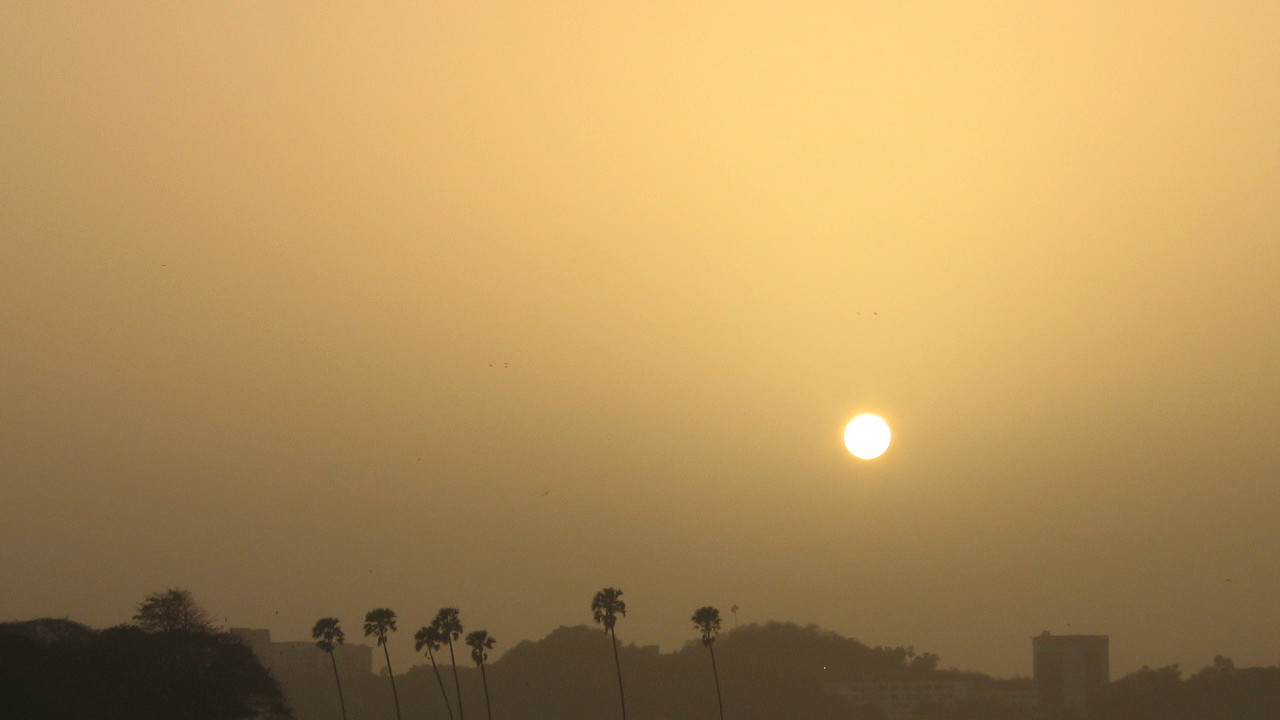
Haze and HumidityWe've earlier stated that Rayleigh scattering happens on air molecules, but also on dry hazes such as tiny salt crystals or smoke particles floating in the air - the important thing is that the scattering centers are smaller than the wavelength of visible light, which starts at around 400 nm.This raises the question - what about man-made pollution? There is lots of emission above major urban centers - do they have particularly stunning sunsets with brilliant colors? Often they do not, see the following example of a hazy sunset in Mumbai.
The colors look rather bland and not brilliant at all. What is the issue here?
Location mattersAs we've seen, often the most striking elements of a sunset are illuminated clouds. However, in order to illuminate a cloud in red-golden light, the illuminating ray needs to go through a substantial collection of Rayleigh scattering centers.Man-made pollutants are emitted on the ground. In a high pressure situation with relatively clear skies which allows to see the sun, globally the air is sinking and only hot air bubbles reach up from the ground to form convective clouds during the day. This means that pollutants can reach no higher than the convection layer, which is the air beneath the lowest cloud layer - and so they practically never affect scattering on the illuminating ray in the first place. In a low pressure situation, air is globally rising and pollutants could reach higher, however usually low pressure regions are characterized by rainfall which washes aerosols out of the atmosphere, and second the formation of closed cloud layers usually prevents one from observing a sunset in the first place. In order to really affect the illuminating ray and lead to striking colors, pollutants have to be carried much higher. A volcanic eruption is one process which might do that, carrying dust as high as the stratosphere where it can remain for long times. In years following a massive volcanic eruption (like Mount Pinatubo in 1991) particularly striking sunsets have indeed been observed. However, most man-made dust never makes it that high. If pollutants are confined to the convective layer only, they alter the colors of the sunset scene primarily through Rayleigh out-scattering on the view ray - and as we have seen earlier, this tends to give the sky a 'dirty' appearance and actually takes away from the color brilliance.
Humidity mattersThere is a second important effect - many pollutants such as salt, sulfuric acid or nitric acid dissolve in water. This is important for droplet formation from water vapour in the air, because solutions evaporate at a slower rate than pure water. A salt crystal may thus serve as a nucleus for droplet formation, and the droplet can grow till its evaporation rate to the surrounding air equals its condensation rate. The process depends on the chemical that is dissolved, the amount of solvent per water as well as on temperature and relative humidity and is described in meteorology by the Köhler equation.The equation predicts that for humidities approaching 70-80%, droplets grow to a radius of perhaps 50 nm - for lower humidities the size of the droplets shrinks quickly. Thus, even if one starts with pollutants that would typically make up a dry haze, due to the accumulation of water around them, a process that is called aerosol swelling, the haze can be changed into a wet haze that has Mie scattering properties if humidity is high enough. Aerosol swelling can significantly reduce visibility and give the sky a whitish appearance - and in more extreme cases leads to the formation of smog. Such a haze no longer changes the color of light but rather hides the colors behind a bland veil (and getting above the ground have, for instance by climbing a sufficiently high mountain or using an airplane, one would see the sky more brightly colored).
As illustrated by the following impression, aerosol swelling leads indeed to very pronounced Mie scattering. Note also the lower edge of the Mie halo that is still above ground - that is where the haze becomes optically thick and diffuse scattering the main process - which makes the visual impression dark. In the event, the ground haze was so pronounced that the visible sun disc vanished behind it well above the horizon.
Continue with Looking back. Back to main index Back to science Back to sunsets Created by Thorsten Renk 2022 - see the disclaimer, privacy statement and contact information. |