Stichschlac, Nucken, Durchtreten and other TechniquesNext to terminology like ligatio (bind), custodia (guard) or fixura/stich (thrust) which are easy to understand, the Walpurgis-Fechtbuch also contains a few named techniques that are not quite as apparent from text and illustrations. in order to understand these, the manuscript needs to be carefully interpreted as to what the intended idea might be.Examples for such techniques are stichschlac, nucken or durchtreten - a quick internet search reveals that there doesn't appear a unique and widely accepted answer what exactly these might be, so for any interpretation that is advanced, the reasoning behind needs to be transparent. A few more techniques are, while not trivial to parse on a first reading, still straightfowrard to identify. Clues to be used in an interpretation are threefold: First, the name of the the technique is frequently descriptive. Second, the illustration can, within limits, reveal what starting and/or endpoint of the technique are and third, following the sequence of actions allow to judge what makes sense from a martial arts perspective at the particular point where the technique is supposed to be executed - and what doesn't. As argued in How to read the Walpurgis-Fechtbuch, one should be careful not to over-emphasize the illustrations - some of them are clearly anatomically impossible, others are rather unclear. Images of the I.33 manuscript are used here under the Royal Armouries Non-Commercial Licence on the grounds that this article constitutes non-commercial research work into historical swordsmanship. In the following, page references are indexed following the I.33 manuscript scans, 5v means page 5 verso, 19r refers to page 19 recto etc.
StichschlacThe stichschlac is mentioned twice in the manuscript - on 2R it occurs in the text as a possible counter and on 10 R its end position is illustrated while 9V shows the position from which the technique is begun.The term stichschlac(h) combines stich (thrust) and schlac (cut) and suggests an action that somehow combines a cut and a thrust. This brings to mind for instance a cut that is done to position the point such that a thrust can be performed. Let's start with the situation that is discussed on 2R. Walpurgis on the right threatens halpschilt and the priest Ludger on the left binds from below. 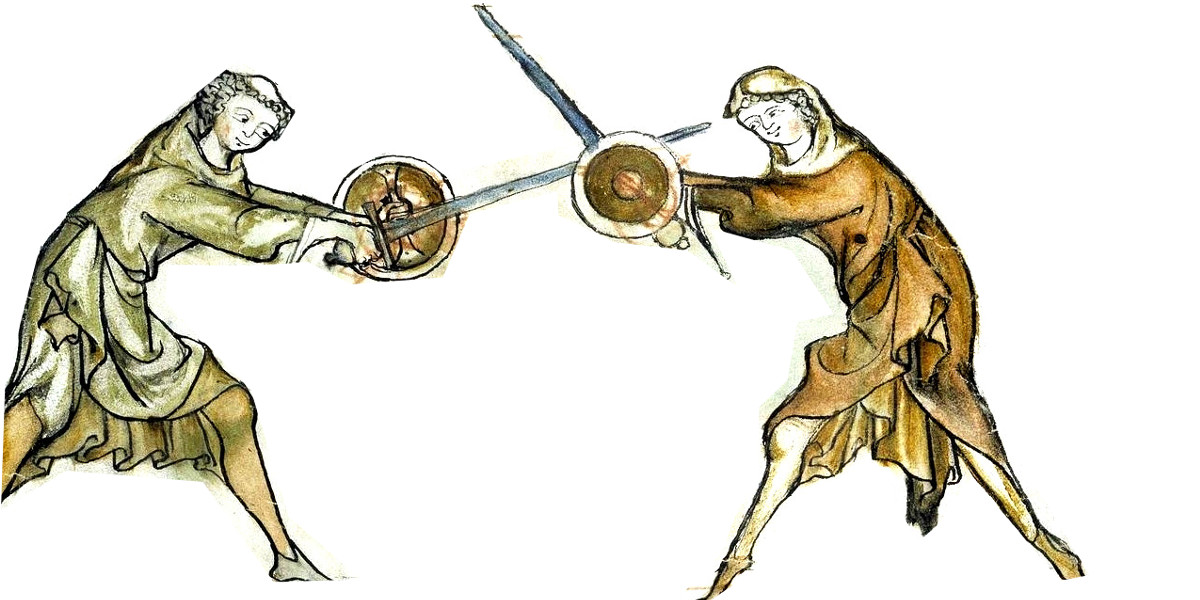
The text states When halpschilt is executed, fall below sword and shield. If he is common, he will go for the head - then for you stichschlac [needs to be done] (1). Walpurgis has the upper hand in the bind, so it indeed seems like she might be tempted to use that position to just press forward and cut at Ludger's head. Logically - what would Ludger have to do to counter this effectively? First of all, he would have to raise his right hand to block the attack with his strong. If he keeps the sword 'as is' while his hand goes up, it would then point upward - but if he turns his hand so that the false edge faces down, he can bring the point towards Walpurgis' face and thrust. In essence, such an action would be a false-edge cut (a kind of one-handed schielhau) to position the blade for a thrust - which fits the name rather well so far. Let's see whether that idea agrees with the second situation that mentions the technique. On 9V both fencers stand in a low bind- but with their hands crossed (this is visible for Ludger and implicit for Walpurgis as her shield wouldn't face the viewer and obscure the handle of the sword unless she has hands crossed as well).
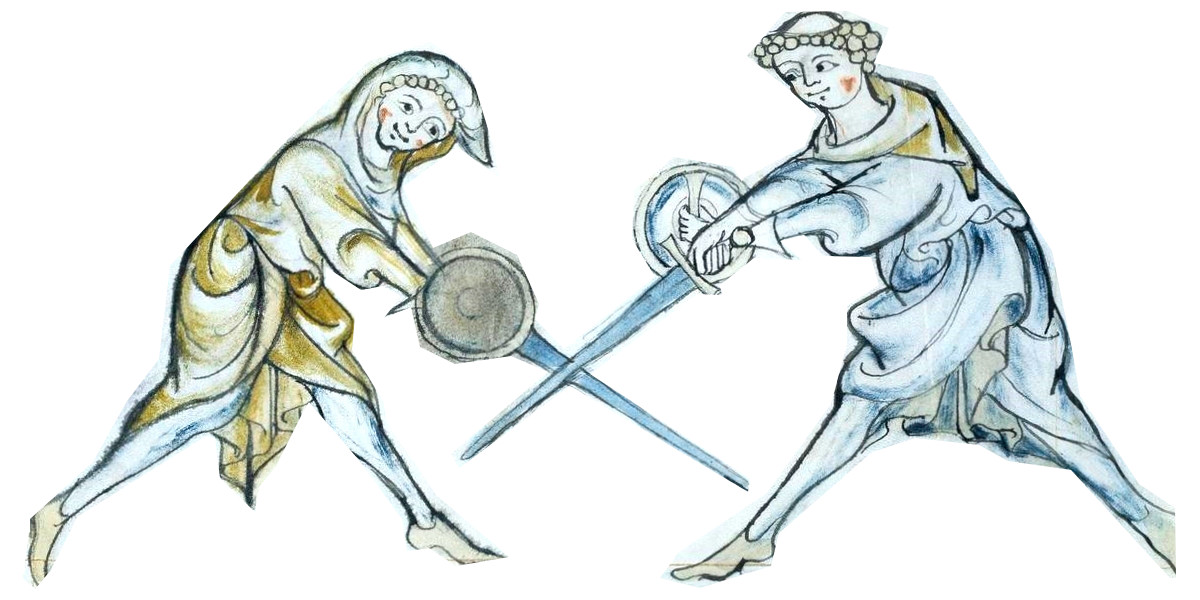
From this situation, Walpurgus now does a stichschlac - as the text states Now truly as the priest is in the act of binding above he advises the scholar what she should do then, namely stichslac (2). The result of this - the priest apparently being hit by the thrust, is depicted on 10R:
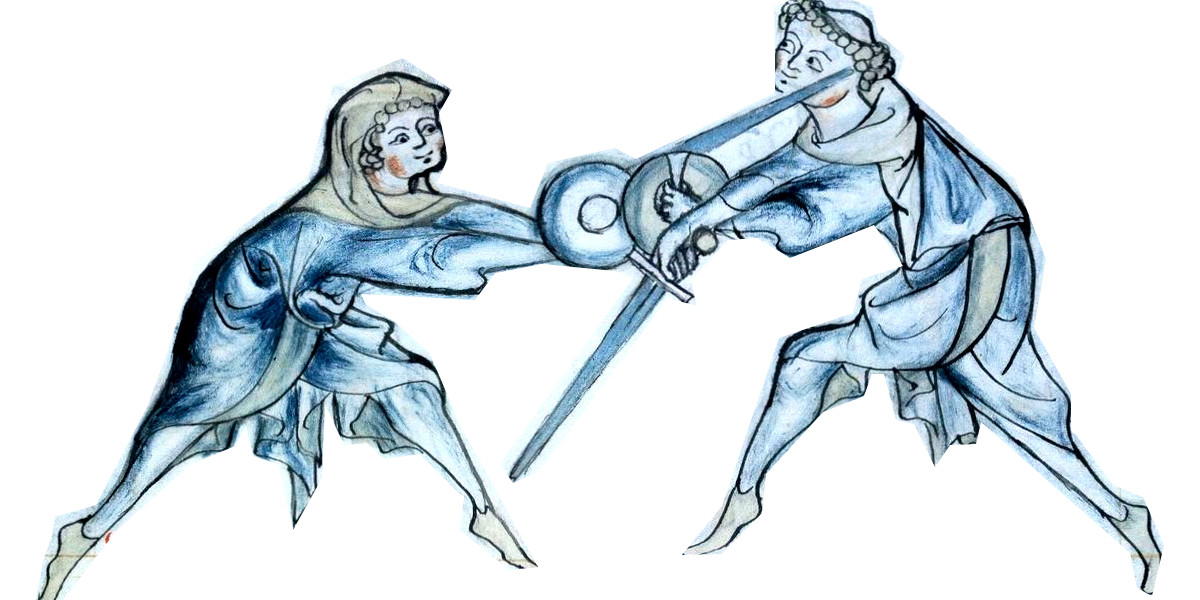
Now, what is suggestive about this is that the line of hand and sword is drawn different from how a stich is depicted elsewhere, see the comparison with Ludger doing just stich thrust) on 20R:
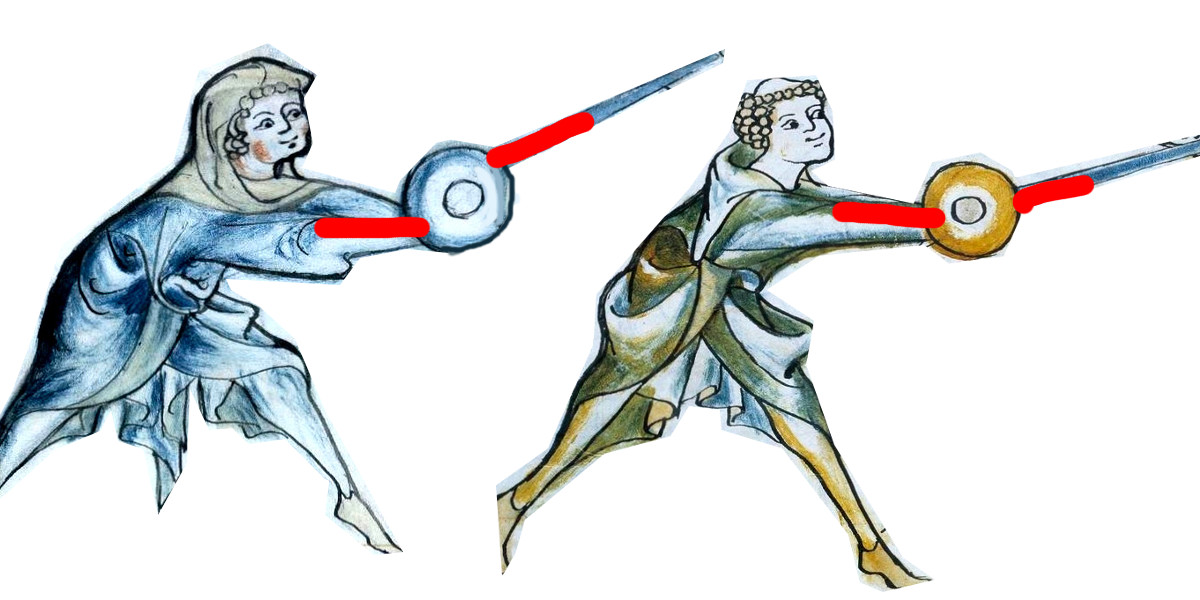
The way upper arm and sword do not seem to run into the same point behind the shield suggests that Walpurgis' sword is in fact turned such that the false edge faces down (whereas in the comparison, Ludger's sword faces down with the true edge). This, again, agrees with the idea that Walpurgis has done a false-edge cut to position her blade. What false edge cut leads from the bind to the thrust? The obvious solution is whirling her sword around (akin to schnappen) - usually Walpurgis could not easily do that because her buckler would be in the way and she'd cut her left arm - but remember that she started the bind with arms crossed - so this is now entirely possible. Here's a possible way to do the whole sequence (note the different line of upper arm and sword in the last picture):
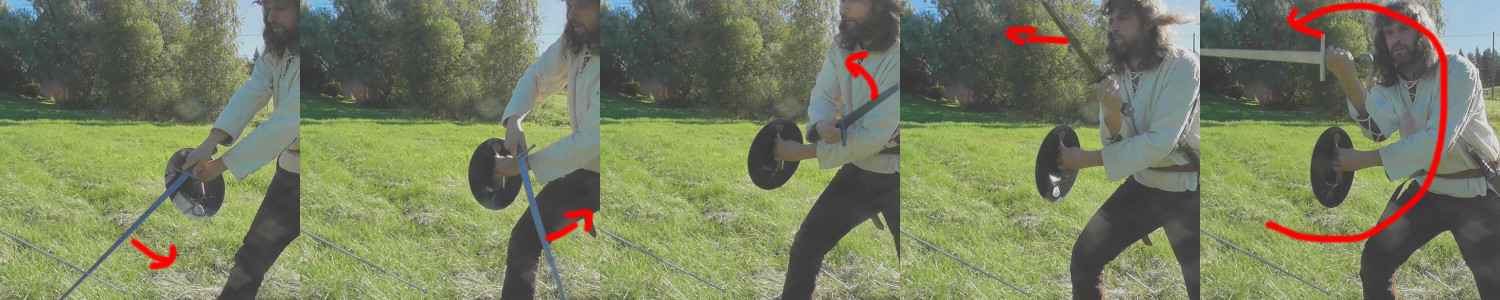
In fact, given that the hands are crossed, this feels like a natural way to get free from the bind and counter. So, very likely the term stichschlac denotes a false-edge cut to position the point of the sword for thrusting.
NuckenThe technique called nucken is mentioned only on 3V by name (but possibly it is conceptually shown more often).The term is etymologically related to 'the verb to nod' and means something like 'to bend, to press, to push'. The context in which it appears is that the priest has just completed a mutatio gladii to bring his sword from being bound below on top:
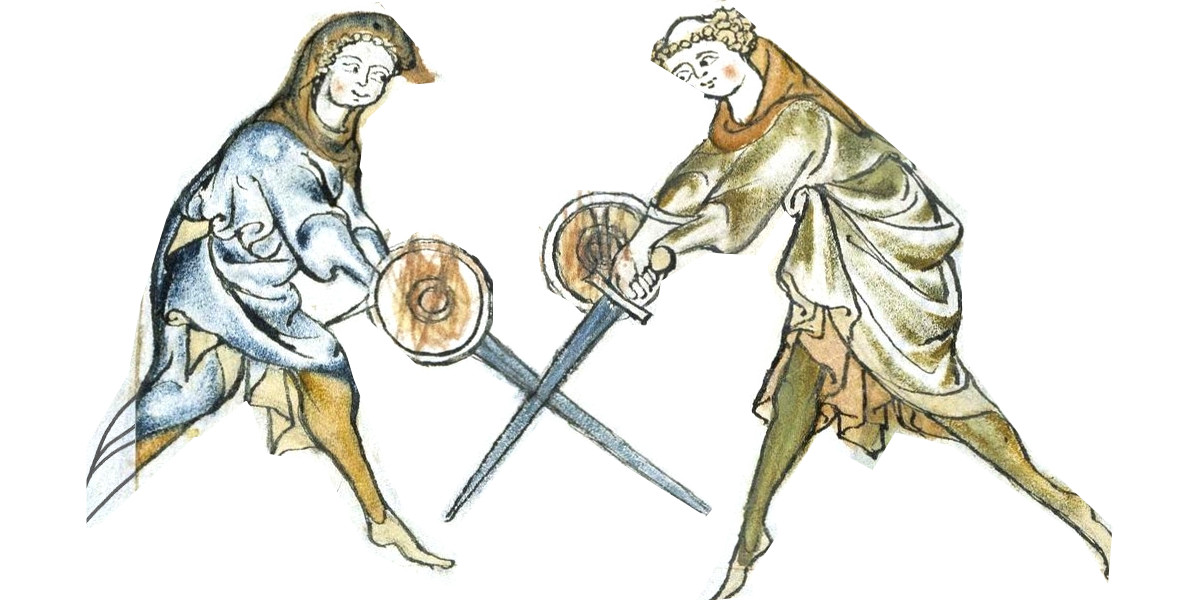
This is explained as It is to be noted how the priest changes the sword because it was below but now it truly will be above, then he leads the sword to the head of the opponent which is callednucken from which a separation of the scholar's sword and shield is created. (3) A verse accompanies this explanation: Thus the cleric's nucken [where] the commons [execute] schutzen. (4) How is the mentioned separation of Walpurgis' sword and shield to be achieved? One way is if the illustration depicts the moment when his sword comes from above and cuts hard onto her blade, pushing it down (and opening a gap between her sword and shield). The other way is if he, from the position illustrated, cuts hard upward and impacts at a shallow angle with her blade, dislodging it just enough for his sword to slip through. While the latter possibility seems to be supported by the text 'he leads the sword to the head', it is biomechanically difficult to achieve a good cut from the position. Moreover - why should Ludger have an alternative between nucken and schutzen (pulling the buckler up to protect his head) in this interpretation? But he has that alternative before the mutatio gladii that changes his underbind to an overbind - if he is bound from above, Walpurgis can threaten his head - and he can react by protecting it. Yet he does not - he brings his sword on top, in doing so gives her sword a sharp tap downward and then cuts upward. The end result is that his sword slipped between Walpurgis' sword and shield just like the text claimed - this is shown on 4R:
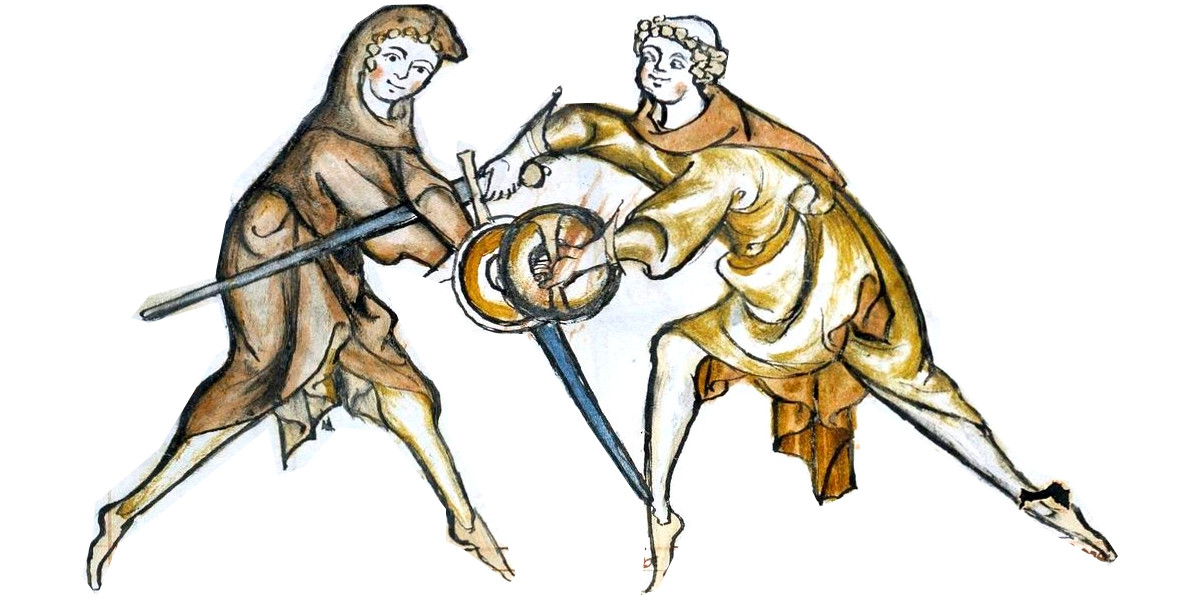
Since the act of bringing the sword from being bound below around to binding above is identified as mutation gladij inferioris (change of the lower sword) by the text for both panels of 8R, the most plausible interpretation for nucken then is that it means the action of cutting against the blade to achieve a separation of the opponent's sword and shield, followed by an attack through that gap. If so, the text on 3V would be slightly misleading as it doesn't mention a cut against the blade at all - but perhaps that is too obvious an action to deserve mention. A bit more of a puzzle is that on 11R another example of a separation of sword and shield by means of a cut is mentioned, but not linked to the term nucken. Here the text states that only common fencers try that however - whereas above nucken in the verse was what common fencers do not do. So, while it's reasonably clear what sequence of actions is described by the text, the precise meaning of nucken is a bit less clear - is it a general term for a cut at the blade, followed by an attack? Or is it a specific term for the particular continuation of the mutatio gladii depiced here? Does the verse mean that the priest generally prefers beating at a blade over blocking it - or does the verse refer only to the particular situation? (Given how often another verse about 'binding and the bound' is repeated in the manuscript, I tend to believe that verses in the text refer to each specific situation and hence that nucken is meant to identify the particular continuation of mutatio gladii shown here, not any strike to separate sword and shield.)
Mutatio gladiiAs stated above, the mutatio gladii inferioris (change of the lower sword) is treated on 8R and is not particularly controversial in its interpretation.For the sake of illustration, a possible realization is provided here:
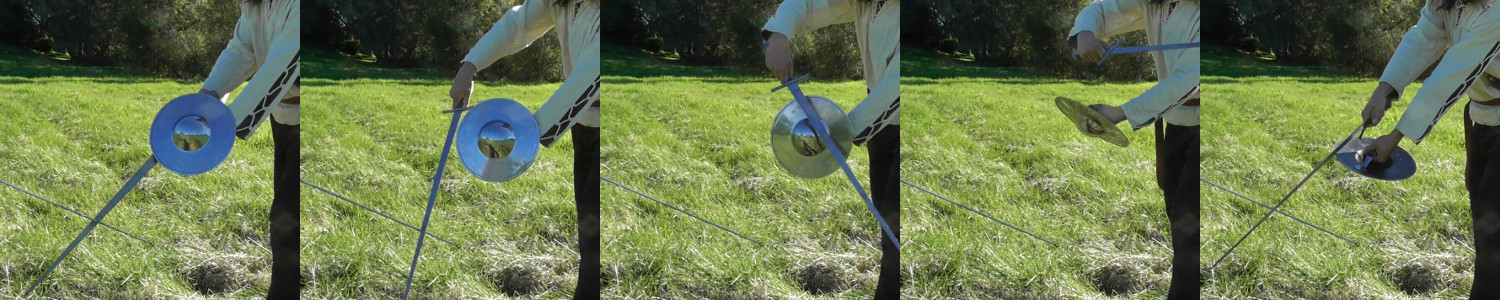
Initially the sword hand is moved along the edge of the buckler while the sword is pointed backward to get free of the bind, as soon as that is the case the right hand is rised and brings the sword around, at that moment the left hand starts turning the buckler, when the sword is again pointing into the original direction, it is sharply brought downward to fall upon the other blade from above. In essence, the motion is a two axis rotation - in one axis the sword is moved full circle, in the other axis it is turned about 90 degrees backard to get free of the bind and once that is the case, the rotation around this axis is reversed while the other continues.
DurchtretenOf all the terms for techniques occurring in the manuscript, durchtreten is perhaps the most difficult to interpret. The technique is mentioned twice, first on 2V in passing and then on 9R and 9V illustrated, albeit from a different situation.The term durchtreten (or the derived noun durchtritt) translates as 'to step through'. This reminds of durchlaufen (to run through) from the Liechtenauer system for longsword with the meaning 'to get into wrestling distance in the cover of a hanging parry' (i.e. with the sword held high but point downward to the rear over the shoulder such that a high attack by the opponent slides off and the fencer can 'step through' a kind of 'doorway' formed by his own sword). Now, clearly durchtreten here does not refer to wrestling (text and illustration are clear about that), but equally well, the term denotes a motion forward towards the opponent. Now, let's start with the situation depicted on 2V. Ludger has bound from below on 2R, here Walpurgis has decided to accept the bind and push both blades down with the idea of doing a schiltschlac later.
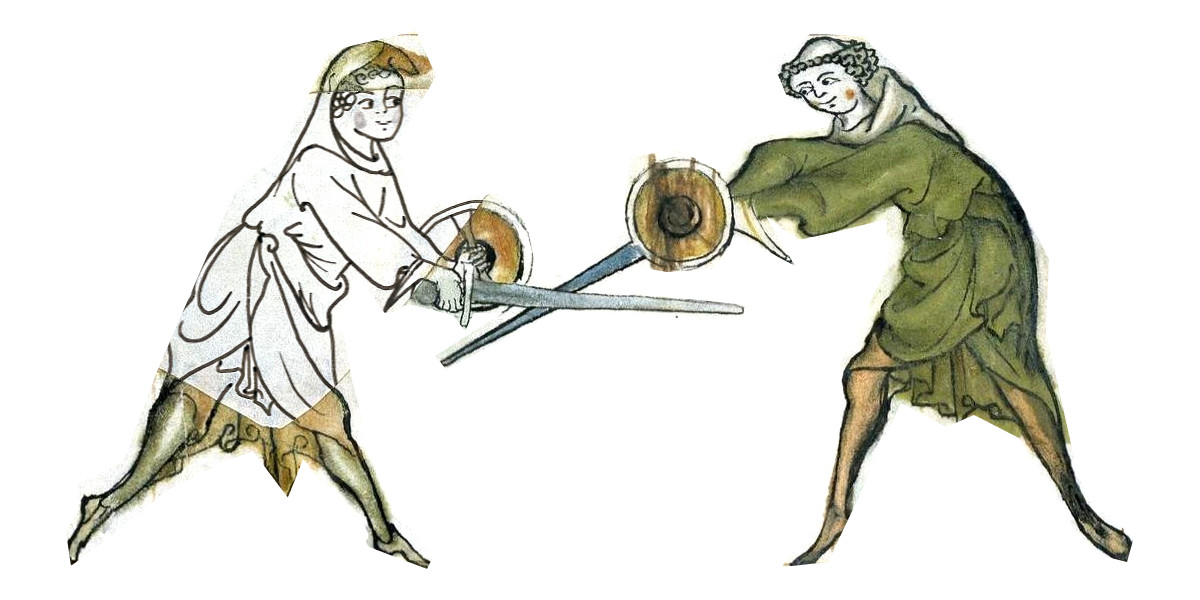
A prose text as well as a verse list of the options of both fencers. As for Walpurgis (the scholar), the text states: it is to be noted that the scholar has no options but schildschlac or to enclose the arms of the priest with the left hand, namely sword and shield (5) and the verse summarizes Here the scholar accepts the bind and presses, for him a schildschlac or with the left hand he encloses the arms of the cleric (6) As for the options of Ludger the priest, the text reads: The priest however has three options, that is mutatio gladii so that he is above, durchtreten or with the right hand he can catch the arms of the scholar (7) amd the verse lists the same options Here three are for the cleric - durchtritt, mutatio gladii or he can with the right hand catch sword and shield [of his opponent] (8). Now, this doesn't at all clarify what durchtreten is supposed to be, but there is more here than meets the eye. First, note that a page before the priest was advised if he accepts the bind and presses, then for you schiltschlac (9) - but now that Walpurgis has bound and pressed, the schiltschlac is curiously absent from the three options Ludger has listed. Is it perhaps implied in the durchtritt? We have a relatively clear picture how mutatio gladii or a grappling move look like and they do not use a schildschlac. The other significant fact is that while Walpurgis can reach for Ludger's arms with her left, he has to use his right hand. Why is that? The answer is because of something that the illustration does not capture - the bind is not symmetric, Walpurgis needs to press down on her right side, so both swords are right of her center line - which is why if he turns forward-inward, her left arm can reach, but the opposite is true for Ludger. Let's now take a look at 9R which depicts the situation before durchtreten is done:
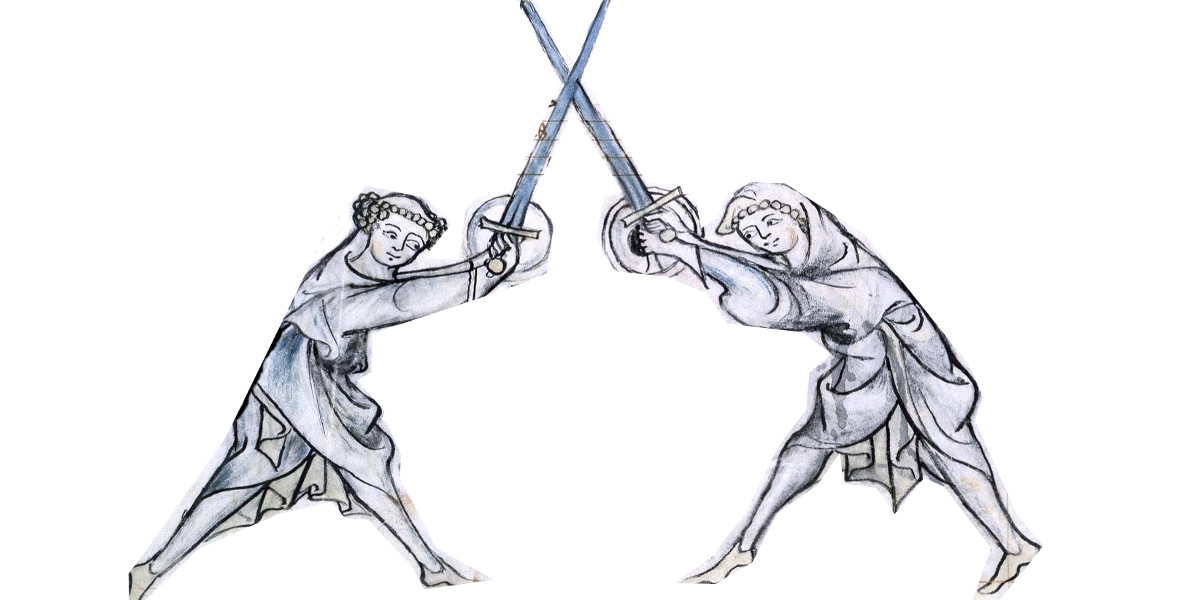
Again we see a bind, this time it is a high bind, but again it is not symmetric: While Ludger is holding sword and shield normally, Walpurgis has her hands crossed (her buckler faces the same direction as Ludger's). Again there are three options for both fencers: First he can squeeze the sword down and then durchtreten, second he can do a cut to the right side, third he can do a cut to the left side (10) The cuts to the left and right are likely standard bind plays - seek pressure in the bind and then either release the bind and cut around (left side) or yield with the strong while cutting right with the weak (duplieren in longsword terminology). Ludger is advised to push down and step in - what can he gain? The next illustration gives a clue, it shows the result of the durchtritt (confusingly enough, the text explains that Ludger and Walpurgis have swapped roles as compared to the previous picture, i.e. now Ludger is the one standing with crossed hands and Walpurgis has moved in):
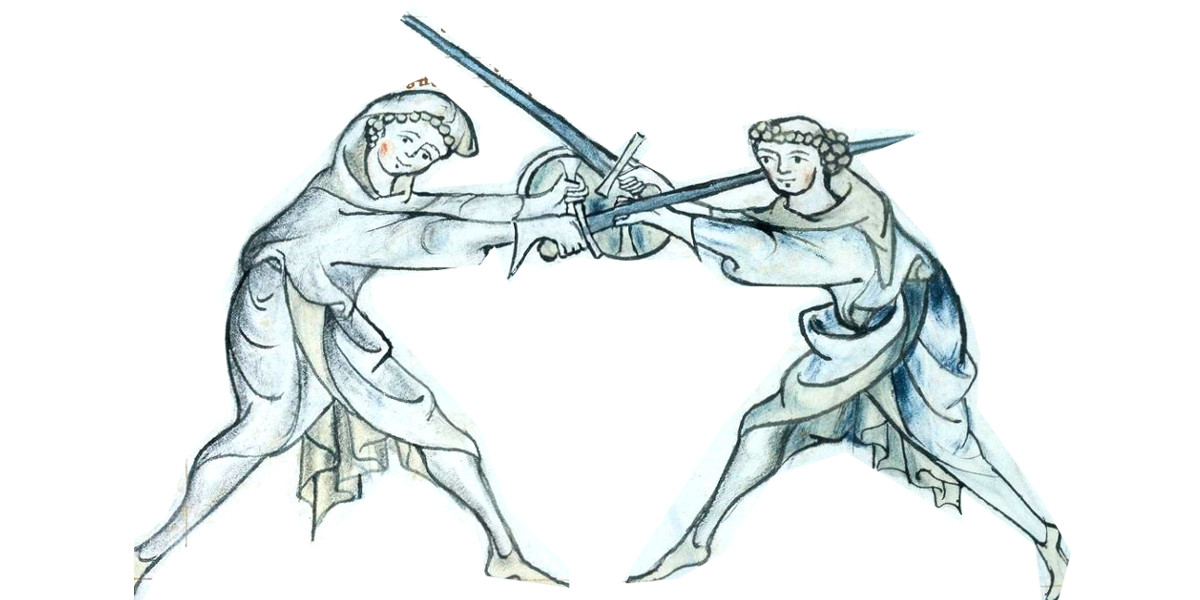
The illustration is anything but clear with regard to which shield is in front of what, but the picture may conceivably mean that the reason Walpurgis stepped in is so that her buckler can be used to take over the bind from her blade while she strikes Ludger's arms (in essence she does something tactically similar to a schiltschlac and blocks Ludger's arms). Let's for a moment go back to the first example where the bound swords were to Ludger's left side - just as here, if he steps forward he can bring his shield to take over the bind (which is on his shield side) and so free his sword for a cut. This could account for the missing schiltschlac option that would then indeed be implied. Could this then be the theme of durchtreten - go forward along the sword in the bind till the shield can take over, then strike with the sword? The description continues with He can however do a cut to the left (which is done by common fencers) as well as to the right (which counsels the priest). Against these two possibilities, the priest may with the sword under the arm reach the bare hands of him who executes the aforementioned cuts. (11) The first part of the sentence may imply that it is easier, once the shield takes over the bind, to just turn the hand and continue with the sword into the direction it was pressing to the far left - but in principle the defender can move his own buckler to intercept - which is why the author of the manuscript prefers to reverse direction of the sword to cut to the arms as shown in the illustration. The second part is a bit more obscure. The phrase manu sub brachio (sword under the arm) is also used to describe the first guard, so it may just imply that the sword is pulled quite a bit back so that the tip can reach the hands of the attacker. Or it may mean that the sword needs to be brought around below the shield arm. Be that as it may, the above interpretation of durchtreten explains 1) why schieldschlac is not explicitly listed as option on 2V in spite of being clearly mentioned on 2R (because using the shield is part of the technique), 2) why Walpurgis on 2V does not have the option to do durchtreten (it requires a bind to the left of the fencer where the shield can be used) and 3) what action is depicted on 9V (the cut to the right as counseled by the priest following the shield bind).
SchutzenThe term schutzen is used on as many as seven pages of the manuscript. Part of the explanation may be that every guard has its protection, i.e. schutzen (12). Just as the text states, the meaning of schutzen is 'to protect'.The illustrations show quite different variants of this concept - presumably because there is one for every guard, cf. for example 9R and 31V:
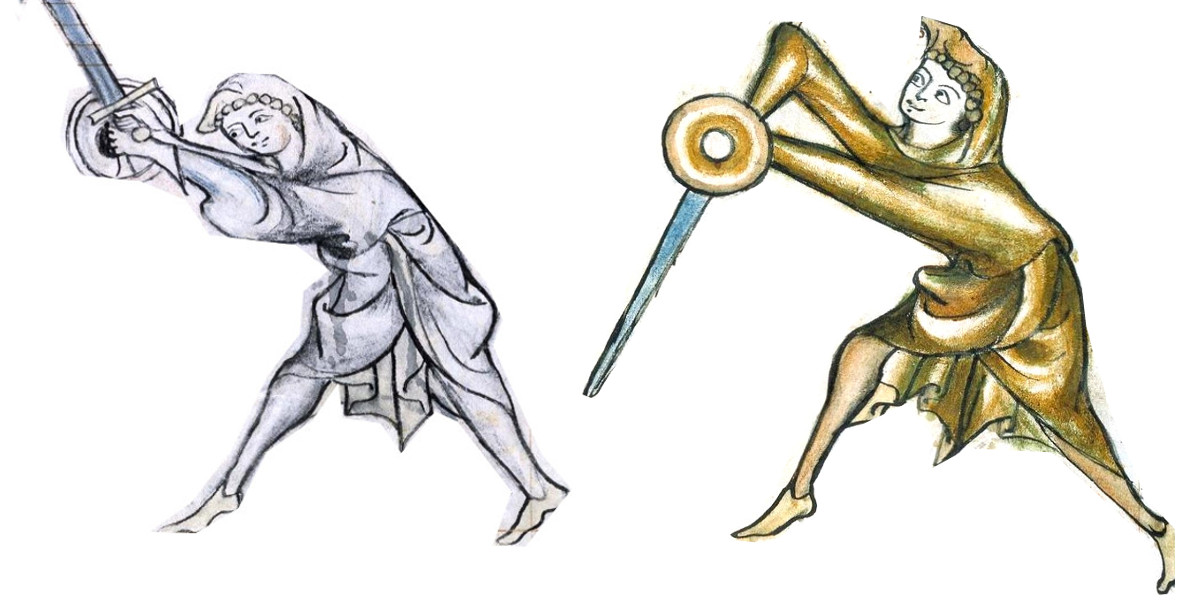
The first shows a high position with crossed hands, the second a sword pointed downward instead with the sword hand pulled back. The downward position should perhaps be compared to another, rather different one to see the relevant details - krucke from 4R:
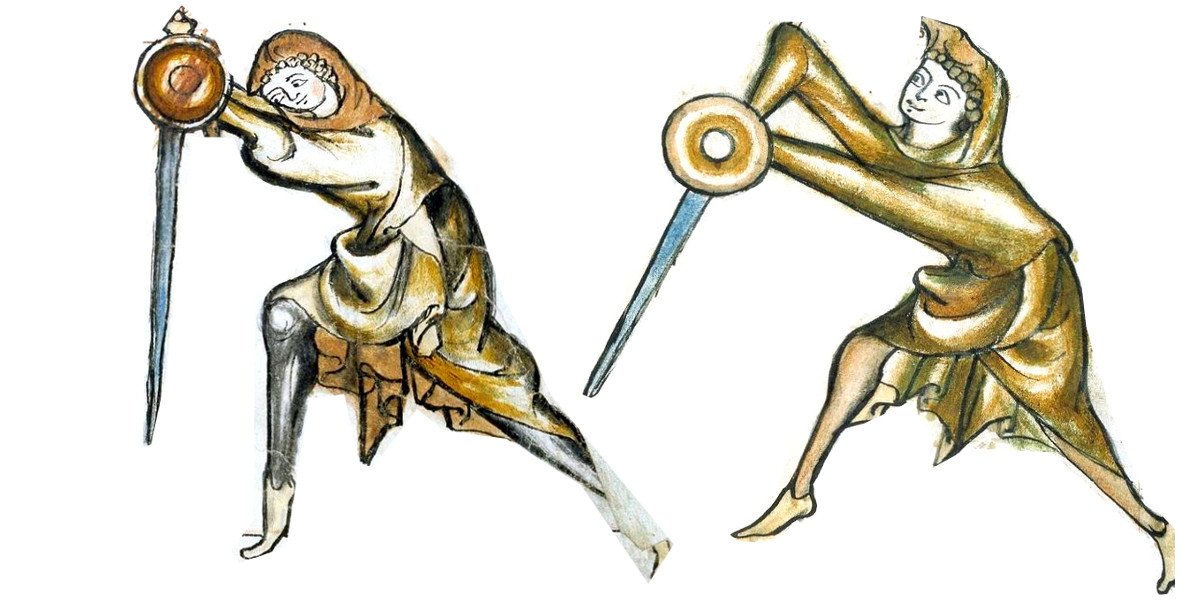
While krucke appears to show the sword and shield hand next to each other, schutzen here is consistent with hands crossing under the shield (and generally taking cover behind the shield). So - what is the deal with the crossed hands? The likely explanation is given on 11R where Ludger manages to part sword and shield with a well-placed cut and so penetrates Walpurgis' halpschilt:
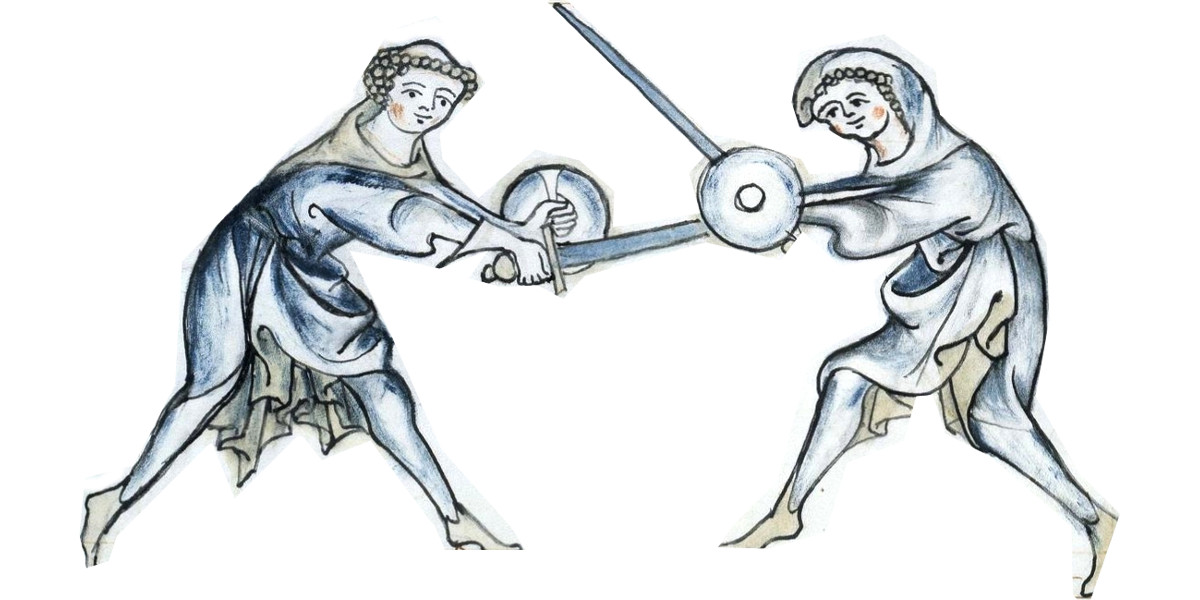
Such a cut simply does not work when the hands of the opponent are crossed (on the other hand, crossing hands obviosuly restricts mobility). So crossing hands makes for well-defensible positions which are immune to the 'parting strike' Ludger demonstrates above - which is a plausible realization of the concept schutzen.
SummaryWith various degrees of certainty, this article advances interpretations for some of the less clear named techniques of the Walpurgis-Fechtbuch.
Original quotes (English translations above by myself): (1) Dum ducitur halpschiltcade sub gladium quoque scutum - Si generalis erit recipit caput sit tibi stichschlach (2) Hic vero cum esset sacerdos in actu superius ligandi informat scolarem quid sit faciendum aduersus hec videlicit stichslac (3) Notandum quod sacerdos mutat gladium hic quia fuit inferior nunc vero erit superior demum seorsum ducit gladium post capud adversarij sui quod nuncupatur nucken de quo generatur separatio gladij et scuti scolaris. (4) Clerici sic nucken generales non nulli schutzen (5) Notandum est etiam quod scolaris nichil habet aliud facere quam schiltslac vel circumdare sinistra manu barchia sacerdotis videlicet gladium & scutum (6) Hic religat calcat scolaris sit sibi schilslach, siue sinistra manu circumdat brachia cleri (7) Sacerdos autem tria habet facere videlicet mutuare gladium vt fiat superior siue durchtreten vel dextra manu poterit deprehendere brachia scolaris [...] (8) Hic tria sunt cleri durchtritt, mutacio gladii dextra siue manu poterit deprehendere gladium schutum (9) Si religat calcat, contraria sit tibi schiltschlac (10) Primo potest exprimere gladium deorsum & tunc durchtreten, secundo potest recipere plagam latere dextro, tertio potest recipere plagam latere sinistro (11) posset tamen recipisse plagam tam sinistram que ducitur ex parte dimicatorum generalium quam dextram que consueuit duci ex parte sacerdotis [...] Contrarium illarum duarum viarum erit sacerdotis euntis cum gladio sub brachio qui tunc attingit manus nudas ducentis plagas supradictas. (12) quetlibet custodia tenet vnam proteccionem i. schutzen
Liber de Arte Dimicatoria on Wiktenauer Back to main index Back to Swordfighting Created by Thorsten Renk 2025 - see the disclaimer, privacy statement and contact information. |